
Introduction: The Crisis in Aravallis
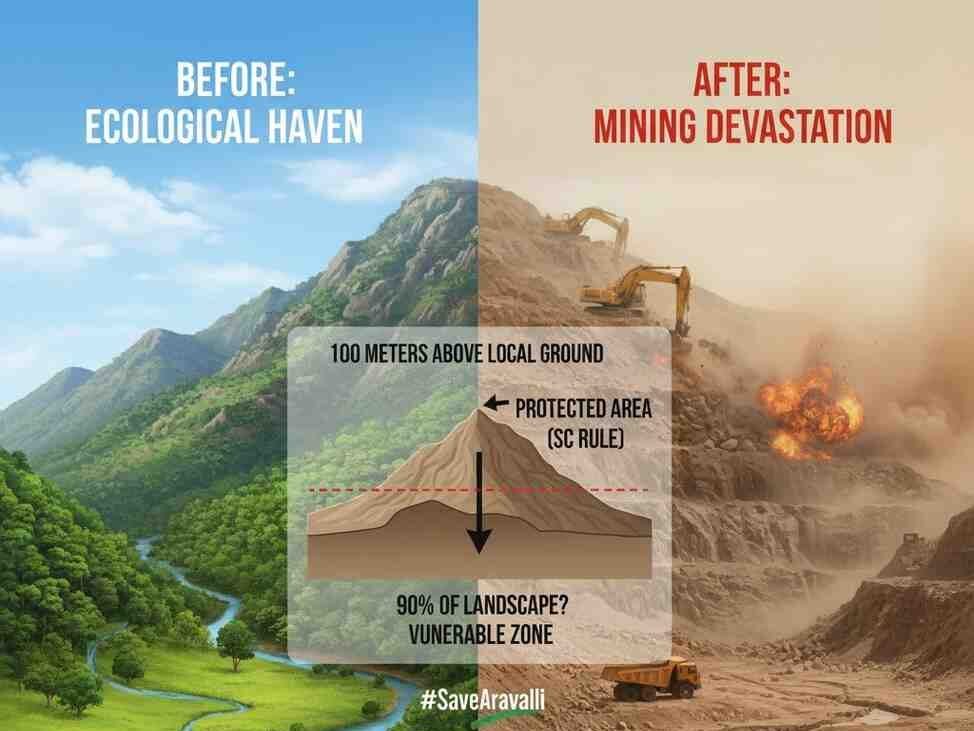
The Aravalli Range, the oldest mountain system in India and a critical ecological barrier against the Thar Desert, is facing an existential threat. In November 2025, the Supreme Court (SC) of India adopted a controversial 100-meter threshold to define the Aravalli Hills for regulatory purposes.
While the government claims this uniform definition strengthens protection and targets illegal mining, environmentalists and critics warn that the rule could exclude over 90% of the range’s landscape from legal safeguards, risking accelerated desertification, groundwater depletion, and unchecked urban expansion.
🛑 What is the Supreme Court’s New Aravalli Definition?
The Supreme Court accepted a uniform, scientific definition proposed by a committee under the Ministry of Environment, Forest and Climate Change (MoEF&CC) to regulate mining.
1. The Core Definitions
| Feature | New SC-Approved Definition (2025) |
| Aravalli Hill | Any landform that rises 100 metres or more above the surrounding local terrain (local relief). |
| Aravalli Range | Clusters of two or more such hills located within 500 metres of each other. The intervening area, slopes, and smaller hillocks are included. |
2. SC Directions and Management Plan
- Mining Ban: A total ban on mining in core/inviolate areas (Protected Areas, Eco-Sensitive Zones, Wetlands).
- Pause on New Leases: A temporary ban on issuing new mining leases until a Management Plan for Sustainable Mining (MPSM) is prepared by the Indian Council of Forestry Research and Education (ICFRE).
- Goal: The SC adopted a calibrated approach, aiming to regulate existing legal mining strictly while preventing the illegal mining that often follows blanket bans.
🚨 Critics: Why the 100-Meter Rule is Flawed
The primary concern is the Aravalli Hills definition controversy—that the technical rule fails to account for the ecosystem’s ecological continuity.
| Ecological Concern | Impact of 100-Meter Rule |
| Exclusion of Landscape | Over 90% of the Aravalli system (according to FSI assessment) consists of foothills, slopes, and low ridges that fall below 100 meters. These areas are now vulnerable. |
| Groundwater Recharge Risk | Lower hills and slopes are crucial for rainwater percolation and aquifer recharge. Disturbing them will severely lower water tables in Rajasthan, Haryana, and Delhi-NCR. |
| Accelerated Desertification | The Aravallis are a natural check on the Thar Desert. Weakening this barrier allows desert sand to drift eastward, increasing dust storms and land degradation (undermining UNCCD goals). |
| Regulatory Loopholes | The peak-centric definition creates regulatory loopholes that may facilitate illegal mining and construction activities outside the defined high-peak zones. |
🌍 The Aravalli Range: A Critical Lifeline
The Aravalli Range is not just a geological feature; it is a life-support system for North-Western India.
1. Geological and Climatic Importance
- Age: One of the world’s oldest mountain systems, dating back 2,000 million years (Precambrian era).
- Climatic Barrier: Acts as a vital barrier that prevents the expansion of the Thar Desert.
- Water Regulator: Functions as a major watershed, dividing drainage systems between the Bay of Bengal and the Arabian Sea.
2. Biodiversity and Economic Value
- It supports dry deciduous forests and provides habitat for endangered species, housing 22 wildlife sanctuaries and three tiger reserves (e.g., Sariska).
- The region is rich in minerals, including zinc, lead, and marble, with Rajasthan accounting for approximately 80% of the range’s mineral wealth.
🌿 Conservation Efforts: The Way Forward
The future of the Aravallis depends on shifting from reactive bans to holistic, landscape-level restoration and regulation.
1. Landscape Restoration
- Aravalli Green Wall Initiative: Inspired by Africa’s Great Green Wall, this MoEF&CC led initiative plans a 1,400 km long and 5 km wide green belt from Gujarat to Delhi to reverse land degradation and combat desertification.
- Local Wisdom: Strengthening indigenous watershed management systems like taankas and jhalaras in Aravalli villages.
2. Strengthened Enforcement
- Scientific Mapping: The need for comprehensive mapping of the entire ecological system (slopes, recharge zones, corridors), as recommended by the Central Empowered Committee (CEC).
- Technology for Oversight: Deploying drones, satellite imagery, and e-challans to curb illegal mining and ensure strict adherence to the new sustainable mining plan (MPSM).
Conclusion: An Ecological Imperative
The Supreme Court’s attempt to provide regulatory clarity through the uniform definition of the Aravalli Hills has inadvertently ignited a new debate about the true extent of the range’s protection.
The degradation of the Aravallis is an ecological, economic, and civilisational imperative for India. Moving forward, authorities must adopt a landscape-level strategy that ensures all parts of the ecosystem, especially the critical lower slopes and valleys, are protected from unchecked mining and urban pressure.
Source: PIB